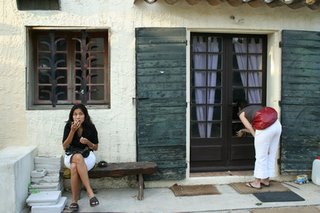
What you get when your blogger is too busy eating she forgets to take a picture...
I must be in France because the word "barbecue" doesn't mean an old manang or a pouting bading standing in a street corner, indifferently waving anahaw fan over red-black coals smoldering inside a rusty box with a grill on top, cooking five-peso sticks of fatty pork and chicken innards marinated in Jufran ketchup, for the office worker going home and too tired to cook anything, so this is dinner, or for the kanto boys who for once have decided to not spend all their money on the gin and the beer, so this is pulutan.
Instead "barbecue" is a celebration, the beginning of warm days spent outdoors sunning on the terrace and taking quick dips in the pool when one gets too hot. Today the women are all together on the giant hammock talking about their men, who are there, gathered around the grill.
The loudest (yes, that would be Pierre) is declaring that here, in the Camargue, barbecue is a religion, prepared for as early as October, when the locals gather the twigs fallen off after the grapes have been harvested. Dried, these go in with the secret mix of other wood, to give what's cooking a special flavor. ("We never use charcoal," he declares to the visiting Parisian and the guy from Annecy. "That would be sacrilege.") There is also the seasoning with oil and herbes de Provence--rosemary, thyme, marjoram, oregano, basil, and summer savory. Think of it as an aromatic benediction.
Lunch begins with Cindy's green salad. The sauce is simple yet sublime. Olive oil, vinegar, mustard, and shallots are mixed, the strong flavors then tempered with two fresh eggs. When the meat arrives, we agree that the making of it must indeed involve something out of this world. How else can spare ribs, chicken, lamb, and various sausages induce in their diners such ecstasy? We worship with a lot of lip-smacking, the sign of our conversion the grease running down our chins.
Afterwards, everybody wants to take a nap, and not just because we all ate too much: Before lunch we have our beers and pastis, during the eating there is wine, and after there is sweet wine, some whiskey, and even a bottle of champagne. If we paid 30 euros for the meat, then double that must have gone to the beverages. Despite all the ceremony, when you think about it, we really aren't that much different from kanto boys.